



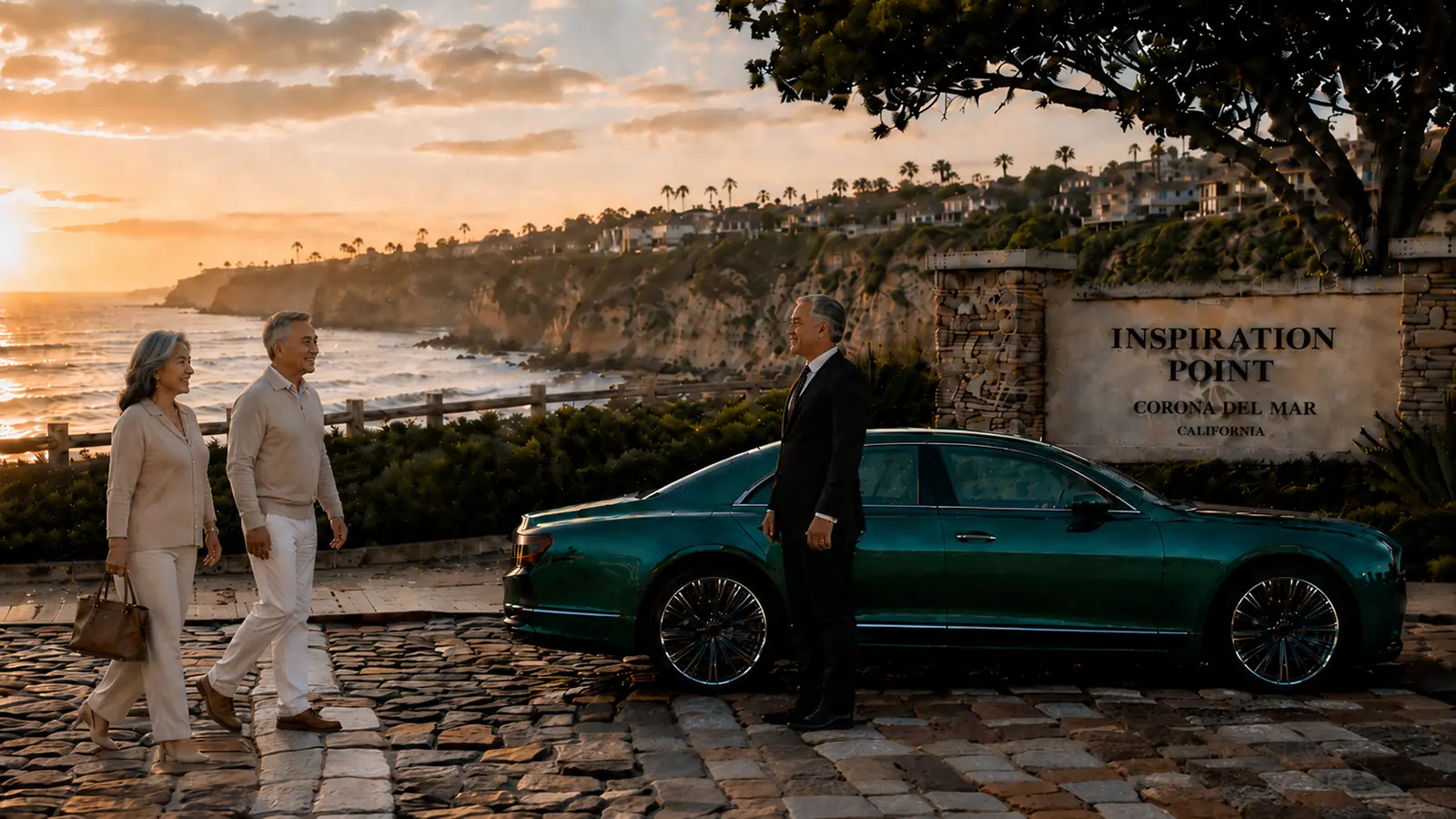

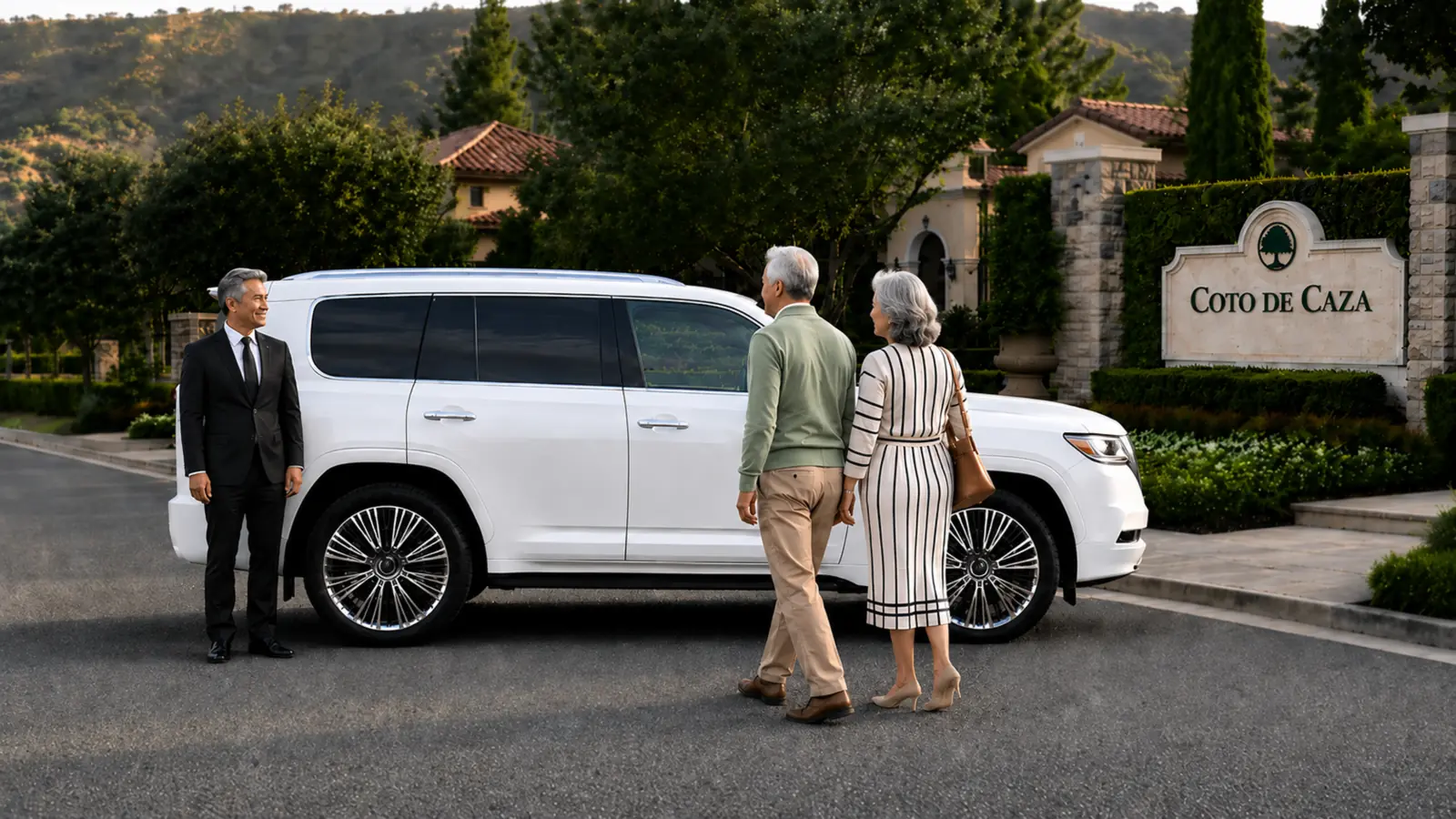







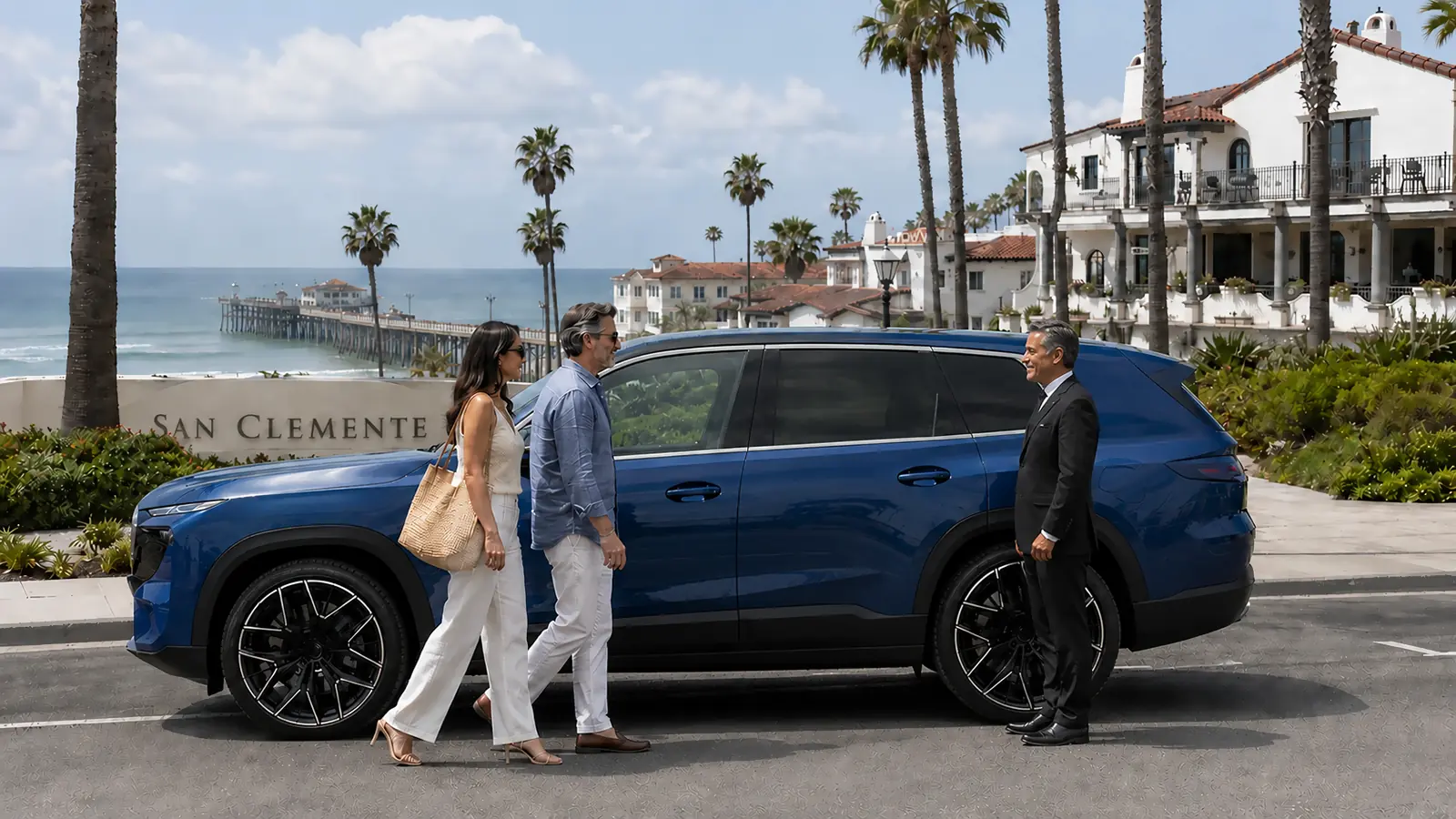
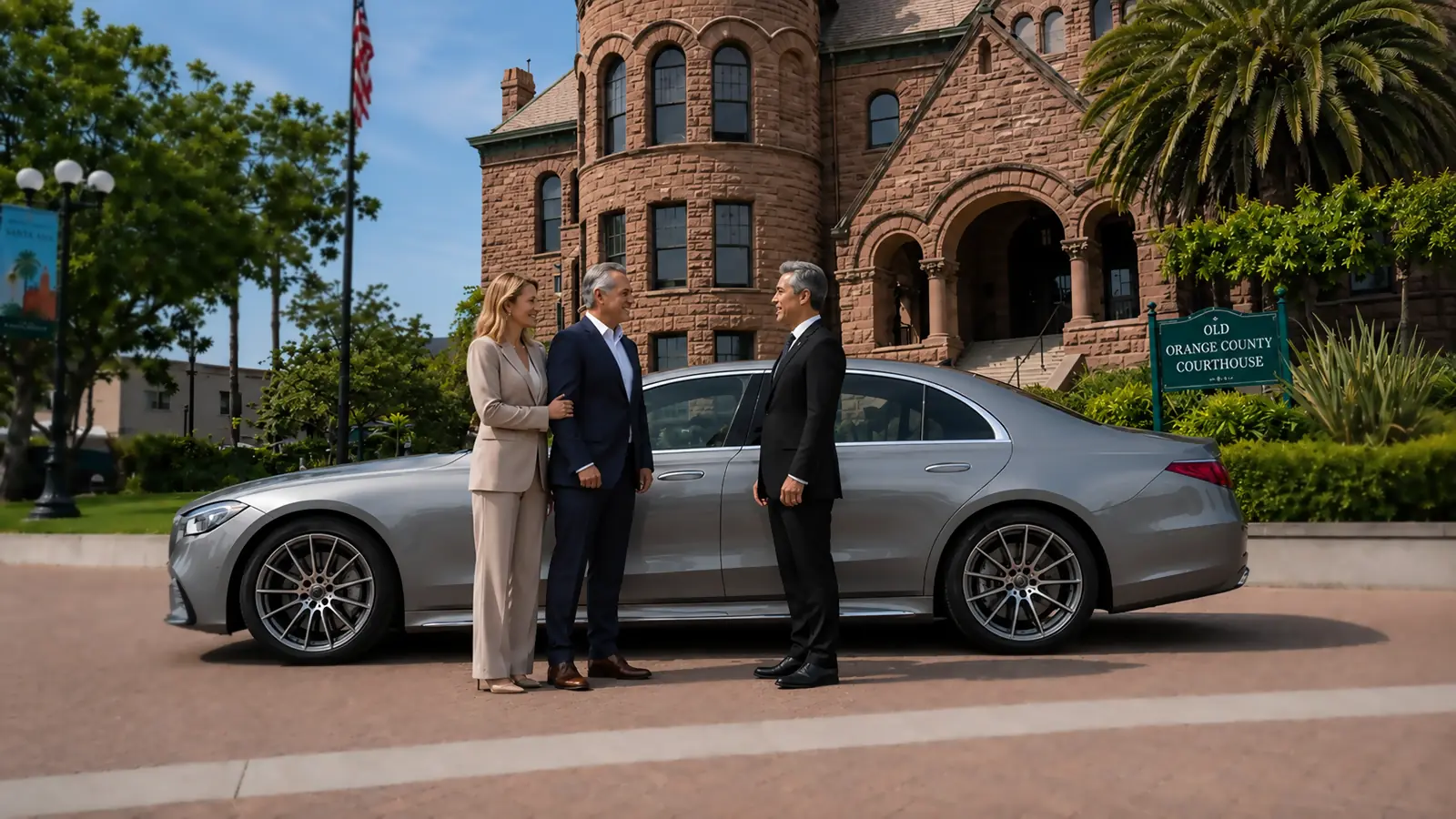
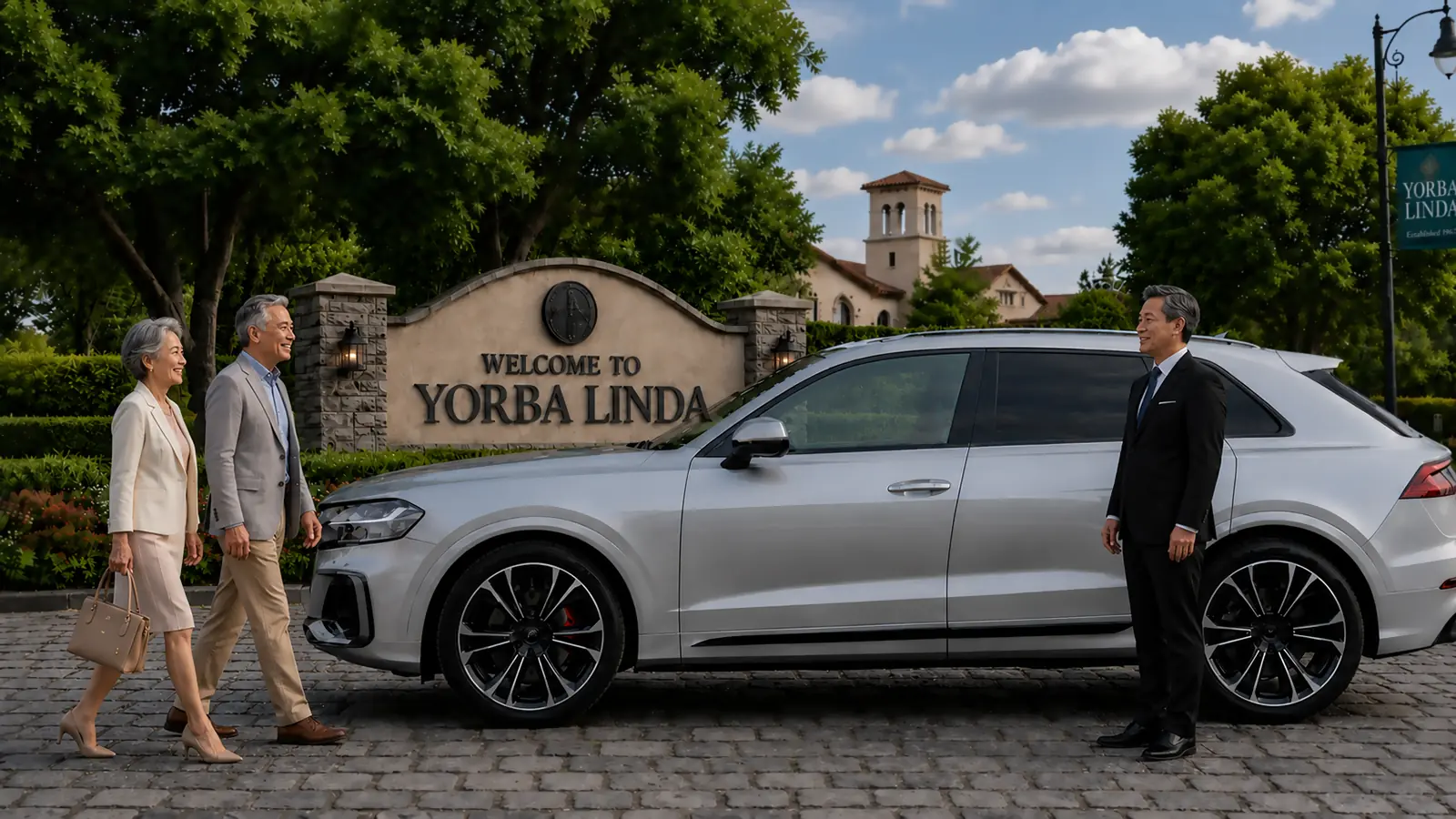
Private driver standing beside a white luxury sedan at an Orange County estate.

Private Driver in Orange County

Your car, protected. Your trust, earned. The Your Car Our Driver promise.

We Serve All of Orange County

Tap any community to learn more.

Do not see your city listed? We serve every community across Orange County. Call or text and we will arrange your private driver.

Private Driver Service in Orange County

★★★★★ 5.0 100% 5-star Google reviews

Hover to pause and read

Touch to pause and read

Orange County Works Through Transitions, Not One Center

Unlike a county organized around one dominant downtown, Orange County has several centers of activity. Anaheim has a resort and event economy. Santa Ana holds major civic and legal destinations. Irvine contains widely separated office, residential, university, and retail districts. Newport Beach faces the harbor and airport corridor. South County spreads through hills, planned communities, and coastal approaches. North County connects closely with Los Angeles County and the SR-91 corridor.

That pattern changes how an Orange County reservation should be built. The first address identifies more than a starting point. It identifies the likely freeway family, the direction of the busiest merges, and whether later stops should be sequenced inland-to-coast or coast-to-inland. A Laguna Niguel morning that ends in Anaheim may benefit from a different order than the same addresses reversed in the afternoon.

We therefore read an itinerary as a chain of transitions. A transition may be I-5 to SR-55, I-405 to SR-73, SR-91 to SR-241, a freeway exit to a canyon road, or a public street to a controlled entrance. Each one can add uncertainty that is invisible in a simple mileage total. Identifying those changes before the reservation helps set a realistic arrival window and keeps the client from solving route questions between appointments.

The Orange Crush Determines the Northern Approach

The junction of I-5, SR-22, and SR-57 near Orange is commonly known as the Orange Crush. It is a countywide decision point for addresses in Anaheim, Orange, Santa Ana, Garden Grove, Fullerton, and the communities farther north. A route that looks direct on a map can require several closely spaced choices, especially when a destination sits on the opposite side of the interchange from the approach.

For a northern event, civic appointment, or university stop, the important question is often which side of the junction should be reached first. Angel Stadium, the Honda Center, Old Towne Orange, the Santa Ana civic area, and Cal State Fullerton pull traffic in different directions. Placing those addresses in a poor sequence can create repeated crossings of the same merge zone. A better sequence keeps the automobile on one side of the junction until that group of stops is complete.

The return plan matters as much as the outbound approach. A late release from an Anaheim venue may send a large volume toward I-5 and SR-57 at once. A client returning toward Newport Beach, Yorba Linda, Seal Beach, or Coto de Caza does not share the same first decision. Confirming the final destination before the event begins allows the assigned person to position the automobile for the correct exit path instead of improvising after the crowd reaches the streets.

"We have built our reputation one client at a time. If any part of your experience falls short of what you expected, I will make it right. You have my word, and every client has my mobile number."

SR-55 Is the Hinge Between Central Orange County and the Coast

The Costa Mesa Freeway, SR-55, is the only freeway providing a direct north-south connection between central Orange County and the coastal region. That makes it more than another roadway. It is the hinge between Orange and Tustin addresses, the I-5 corridor, South Coast Metro, John Wayne Airport, Costa Mesa, and Newport Beach.

A reservation that touches both central county and the coast should account for the position of each stop relative to SR-55. An appointment near Old Towne Orange followed by South Coast Plaza and a Newport Harbor dinner has a natural directional logic. Reversing one middle stop may cause an unnecessary turn back through the same interchange. The calendar should follow the geography whenever appointment times allow it.

Surface-street choices also become important near the southern end of the corridor. MacArthur Boulevard, Bristol Street, Jamboree Road, Newport Boulevard, and Campus Drive serve different sides of the airport, retail centers, offices, and coastal neighborhoods. The destination name alone may not identify the preferred entrance. A building address, parking instruction, or terminal letter can decide which branch is practical.

The I-405 Plan Includes the Vehicle's FasTrak Status

I-405 connects Costa Mesa with Fountain Valley, Huntington Beach, Westminster, Seal Beach, and the Los Angeles County line. Its express lanes extend between SR-73 in Costa Mesa and I-605 near the county boundary. Access requires a valid FasTrak account and transponder. The reservation notes should state whether the equipment is present and whether the client authorizes a tolled option. Entry point, exit point, and the next surface-street approach still determine whether that option fits the itinerary.

The Toll-Road Arc Changes South County Choices

SR-73, SR-133, SR-241, and SR-261 form a tolled network around the coastal hills, Irvine, Tustin, Anaheim Hills, and eastern Orange County. These roads can change the relationship between addresses that appear far apart on a conventional street map. They can also be unhelpful when the nearest entrance points away from the next stop or when a later address requires returning to a different corridor.

A Newport Coast pickup bound for Irvine Spectrum presents a different choice from a Corona del Mar pickup bound for central Irvine. A Coto de Caza departure toward Anaheim Hills presents another. The starting gate, nearest connector, destination side, and toll authorization all matter. Treating every south-to-inland movement as the same trip produces weak estimates and unnecessary mileage.

The reservation record should note the client's toll preference before the automobile leaves the first address. If a transponder or account setting requires attention, that can be resolved at the home rather than beside an entrance ramp. This small piece of preparation is specific to using the client's own automobile and is one reason the booking conversation should cover more than names and times.

Coastal Planning Starts With the Access Point

Orange County's coastline is long, but it is not one continuous arrival environment. Pacific Coast Highway passes commercial blocks, residential stretches, harbor approaches, bluff roads, hotel entrances, beach lots, and compact village streets. A coastal destination therefore needs an access point, not just a community name.

In Newport Beach, Jamboree Road, MacArthur Boulevard, Newport Coast Drive, and the peninsula approaches lead to very different curb situations. In Laguna Beach, a destination reached from Laguna Canyon Road may require a different timing allowance from one approached along the coast. Farther south, Crown Valley Parkway, Niguel Road, Camino del Avion, and the Dana Point harbor approaches divide the hills, resorts, and waterfront into distinct arrival paths.

The practical decision is where the passenger should step out and where the automobile can legally wait or reposition. A hotel porte cochere, restaurant valet, public lot, private residence, and beach access point each require a different answer. We ask for the exact establishment or street entrance whenever the curb is likely to matter. That protects the schedule from a last-minute search on a crowded coastal block.

In a client's words
“We have used Your Car Our Driver for over 30 years. They have always done an outstanding job for our family. Whether it be a trip to LA or San Diego from Orange County or simply a night out, their drivers are always not only extremely professional, but also very pleasant and congenial. We recommend them highly without any reservation! They always provide us superb service!”

★★★★★
jeff stack
Five-Star Google Review

State Route 1 Changes Its Address Language Along the Coast

The coastal highway may appear in an itinerary as State Route 1, Pacific Coast Highway, PCH, West Coast Highway, North Coast Highway, or South Coast Highway. Those labels can describe connected portions of the same coastal corridor, but an address written with the wrong city or directional word may point a search toward a distant section.

Newport Beach properties commonly use West Coast Highway. Laguna Beach addresses distinguish North Coast Highway from South Coast Highway. Dana Point locations frequently use Pacific Coast Highway or CA-1. The reservation should preserve the address exactly as the property publishes it, including the directional term, rather than replacing it with a familiar abbreviation.

This detail matters when the passenger gives a venue name by phone while an assistant sends a calendar invitation with a street number. Comparing the two records can reveal a missing city, an incorrect directional label, or a different branch of the same business. A few seconds of address reconciliation can prevent a long coastal correction.

Newport Harbor, Huntington Harbour, and Dana Point Harbor Are Not Interchangeable

Orange County waterfront plans may refer to Newport Harbor, Huntington Harbour, or Dana Point Harbor. Each name describes a different shoreline network, road approach, and set of passenger meeting points. Even within one harbor, a marina, yacht club, waterfront restaurant, launch area, hotel, and private dock may be separated by water or by a long street route.

A useful waterfront itinerary identifies the land-side property and the door nearest the passenger. A slip number alone may not identify the marina office or parking area. A boat name may be known to the host but not shown on public signs. The booking record can include the marina, dock or gate, host contact, and any instruction for equipment or luggage.

The return should also name the expected landfall. A group that departs from one dock may finish at another after dinner, a harbor cruise, or a private gathering. If the endpoint changes, the assigned person needs the new street-side meeting position, not only the waterfront name. This keeps the automobile on the correct side of the water when the passengers come ashore.

Long Street Names Still Require the Correct City

Several Orange County streets continue through multiple communities or reappear in unrelated districts. Harbor Boulevard crosses Fullerton, Anaheim, Garden Grove, Santa Ana, and Costa Mesa. Main Street, Chapman Avenue, Katella Avenue, Bristol Street, and streets named for canyons or local ranches can also create incomplete shorthand in a busy calendar.

A note that says Harbor hotel or Main Street office is not enough for countywide service. The city, street number, property name, and nearest cross street should travel together. When the destination is near a municipal boundary, the postal city and the neighborhood name may both be useful. When the street changes name, the map pin supplies another independent check.

Exact naming becomes more important when several people share the schedule. The person booking may know the company, the traveler may know the neighborhood, and the host may know the preferred entrance. Combining those pieces in one record produces a destination that can be acted on without asking the passenger to reconstruct the address at the curb.

Canyon and Hillside Addresses Need a Precise Pin

Eastern and southern Orange County include neighborhoods reached by winding approaches, limited through streets, and closely named roads. Santiago Canyon Road, Silverado Canyon Road, Live Oak Canyon Road, Laguna Canyon Road, and Ortega Highway serve different parts of the county and should never be treated as interchangeable shortcuts.

A precise map pin is useful when the street address covers a large property, a side entrance, or a location beyond the most obvious turn. Written gate notes can identify the correct approach without relying on a last-minute phone exchange where reception may be uneven. For an evening return, lighting and house-number visibility may also affect the final approach.

Hillside geography also affects sequencing. A stop in Anaheim Hills followed by one in Yorba Linda may remain within the SR-91 and SR-241 system. Adding a Silverado address changes that logic. In South County, combining Coto de Caza, San Juan Capistrano, and coastal Dana Point requires attention to the entry and exit side of each hill route. The county's road network rewards exact addresses and punishes vague labels.

More than 90% of our business comes from repeat clients.

Guard Gates Change the Arrival Packet

Coto de Caza, Newport Coast, Shady Canyon, and other controlled communities introduce a step that does not appear in an ordinary curb pickup. Security may need a resident name, guest authorization, a specific entrance, or a vehicle description. Some communities have multiple gates that do not offer equal access to every neighborhood.

The booking notes should identify the approved gate and the contact who can resolve an access question. If the automobile begins inside the community, the assigned person may still need instructions for reaching the residence. If the client is being met at a club, event space, or another home, the host may need to place the name on a guest list before arrival.

A gate delay can affect every later address, yet it is preventable when the details are collected early. We prefer to settle spelling, entrance name, host contact, and expected arrival window before the reservation begins. That is a better use of local preparation than adding a generic time cushion and hoping the correct gate is obvious.

Valet Handoffs Require a Clear Key and Retrieval Plan

Orange County hotels, resorts, clubs, restaurants, and event properties often control the curb through a valet operation. The valet ticket, automobile location, key custody, and expected return time should be clear before the passenger enters the property. Without that information, two people may both assume the other has requested the automobile.

The assigned person can remain with the client's automobile when the property permits, use an available legal parking option, or follow the venue's valet procedure. The correct method depends on the establishment and the reservation length. A brief meal, an all-evening function, and an overnight hotel stay do not require the same arrangement.

At pickup, the agreed meeting point should be more precise than the property name. A large resort may have a lobby entrance, ballroom entrance, spa arrival, residence entrance, and event lawn access. A shopping destination may have several structures and valet stands. Recording the exact door protects the client from walking across the property while searching for the automobile.

John Wayne Airport Uses Two Levels and Exact Meeting Markers

John Wayne Airport sits in Santa Ana beside Irvine and Newport Beach, and its SNA code still appears on airline records. Departures use the upper level. Arrivals use the lower level, where numbered columns help identify a meeting position. Curb space is for immediate loading or unloading, so waiting at the terminal curb is not the same as waiting nearby.

For a departure, the terminal letter, airline, luggage plan, and desired curb position belong in the itinerary. The client's automobile reaches the correct level, the passenger steps out with the needed bags, and the vehicle leaves the active curb. For an arrival, the useful update is not merely that the airplane has landed. Baggage status, terminal exit, and column number determine when the passenger is actually ready.

The airport's cell phone waiting area is south of Parking Structure C near MacArthur Boulevard and Campus Drive. It provides a lawful position until the passenger communicates readiness. That location, the two terminal levels, and the numbered markers create a specific airport procedure that differs from an ordinary office or hotel pickup. Clear text communication keeps the automobile from circling before the passenger reaches the curb.

Office Campuses Need the Building Entrance, Not Only the Street Number

Orange County office districts often place several buildings, parking structures, and lobby doors behind one street address. Irvine Spectrum, Newport Center, South Coast Metro, the UCI area, and the airport business corridor each contain properties where the main sign is not the most useful passenger entrance.

A meeting record should include the company name, building name or suite, preferred lobby, parking structure, and any validation procedure known in advance. For a campus with internal streets, a dropped map pin may be more reliable than the postal address. If an assistant scheduled the meeting, that person can often identify the entrance used by visitors or executives.

This level of detail supports a composed arrival without creating a generic business itinerary. The automobile can be placed near the correct lobby, moved after the passenger enters, and returned to the agreed door. If the meeting changes buildings, the client and assigned person already have direct cell contact, so the new entrance can be confirmed without starting a separate transportation arrangement.

Orange, Orange County, and SNA Are Three Different Address Clues

The word Orange can identify the county, the City of Orange, or a business that uses the county name without being located in the city. John Wayne Airport adds another layer because its SNA code reflects Santa Ana. A booking that says only Orange County office, Orange courthouse, or Santa Ana airport leaves room for the wrong assumption.

We resolve that ambiguity with the full street address and the property name. An appointment in the City of Orange may be near Old Towne, a hospital campus, Chapman University, or the county line. A county agency may be in Santa Ana or another municipality. An airline record may say SNA while the passenger thinks of the destination as the Orange County airport. Each label is understandable, but only the complete address identifies the correct approach.

This matters most when one person books for another. An assistant, adult child, event host, or office coordinator may use a familiar shorthand that the passenger understands perfectly. The reservation record should translate that shorthand into a street, city, building, and entrance. Doing so prevents a naming habit from becoming an avoidable detour.

Your car, protected. Your trust, earned. The Your Car Our Driver promise.

Unincorporated Communities Need Their Own Address Logic

Orange County includes large unincorporated areas as well as its 34 cities. North Tustin, Rossmoor, Ladera Ranch, Las Flores, Rancho Mission Viejo, Silverado, and Midway City are examples of community names that may appear in an itinerary even though the booking is not for an incorporated city government.

A familiar community label can hide the roadway that actually controls access. North Tustin may connect through Tustin, Orange, or canyon-side streets depending on the address. Rossmoor sits beside Los Alamitos and Seal Beach but has its own residential pattern. Ladera Ranch, Las Flores, and Rancho Mission Viejo use south-county approaches that should not be reduced to the nearest better-known city name.

The complete postal address, map pin, gate instruction, and nearest cross street are more reliable than substituting an adjacent city. This is also why countywide service cannot be represented only by a list of city pages. We serve the spaces between those city labels and plan from the actual property location.

The Correct Side of the Boulevard Can Protect the Arrival

Wide divided roads are common around Orange County offices, retail centers, airports, and planned communities. Bristol Street, Jamboree Road, MacArthur Boulevard, Harbor Boulevard, Katella Avenue, and Crown Valley Parkway can place the same destination on an inconvenient side of the median when the approach direction is poorly chosen.

The issue is not merely whether the address appears on the left or right. The nearest legal turn may be beyond the property, a driveway may accept traffic from one direction, or the passenger entrance may face an internal road. A route can pass the building and still be several minutes from the correct door. Approaching from the useful direction reduces unnecessary loops and awkward curb maneuvers.

For a fixed appointment, the entrance should guide the final few blocks. For a flexible stop, the preceding address can be chosen to create the better approach. This detail is especially valuable when a client has limited walking tolerance, carries presentation materials, or needs a specific building door rather than the nearest public curb.

Parking Structures Need a Retrieval Record

Large Orange County properties often rely on multilevel parking. Airport structures, medical campuses, office towers, South Coast Plaza, Fashion Island, Irvine Spectrum, civic buildings, and resort properties may each use letters, colors, zones, elevators, or separate wings to identify an automobile's location.

When the automobile is parked, the assigned person can record the structure name, level, row, nearby column, elevator bank, and ticket location. A photograph of the nearest marker can support the written note. That record becomes valuable if another entrance is used later, a meeting ends after the property becomes quiet, or the client asks for an item left inside.

Retrieval planning also includes the exit method. A paper ticket, license-plate system, validation, prepaid account, room charge, or staffed booth may control departure. Knowing the method before pickup helps the automobile appear at the agreed door without an additional search for payment or validation.

Electronic Keys and Garage Access Require Specific Instructions

Modern automobiles do not all begin with a traditional key handoff. The client may use a proximity fob, phone key, key card, vehicle PIN, biometric setting, or app-based permission. A condominium or gated property may add a garage remote, access card, callbox code, or resident credential that is separate from the automobile itself.

The reservation should identify what must remain with the assigned person and what should stay with the client. A phone key may depend on battery power or proximity. A valet card may limit access to storage areas. A garage remote may be essential for returning the automobile after the passenger has entered the building. These details should be explained while both people are beside the vehicle.

Return instructions deserve equal care. The client may want the automobile in a home garage, a guest space, a charging stall, a hotel valet line, or a secured structure. The final key location and access-device location should be confirmed, not assumed. A clear closing procedure keeps the reservation accountable through the last step.

Large Properties Function Like Small Street Networks

Several Orange County destinations are large enough to contain their own internal geography. South Coast Plaza spans multiple buildings and parking areas. Fashion Island has several entrances, structures, valet positions, and department-store anchors. Irvine Spectrum Center, major resorts, hospital campuses, and convention properties also separate passenger doors from the nearest public street.

A property name is therefore the first layer of the destination, not the final instruction. The useful information may be a store, restaurant, ballroom, tower, pavilion, valet stand, or named parking structure. If the client expects to leave from a different part of the property, that second point should be recorded before the automobile is moved.

This internal map affects waiting position and retrieval time. An automobile parked near one anchor may be far from another even though both belong to the same complex. Recording the passenger's likely exit reduces unnecessary walking and makes the return to the curb predictable without depending on a general property address.

Three Keys of Trust

Visibility

Share a live tracking link with anyone you choose so they can follow your vehicle's location in real time.

Communication

Reach your driver by cell.

Assurance

Reach our Chairman and CEO by cell.

Electric Vehicle Details Belong in the Reservation Notes

Orange County clients increasingly use electric sedans and SUVs for local and regional schedules. An EV reservation benefits from knowing the starting charge, expected mileage, charging connector, account or app needed at public equipment, and the client's preferred battery range at the end of the assignment.

A coastal dinner may require no charging decision at all. A countywide sequence followed by a late return may. Hills, air conditioning, freeway speed, waiting time, and an added stop can change the useful margin. The assigned person should not assume that a charging stop is wanted merely because one is available. The client decides whether charging belongs in the plan and which account or payment method may be used.

Charging location also affects the schedule. Equipment inside a hotel garage, office structure, shopping center, or airport facility may have access hours or parking conditions unrelated to the charging unit itself. Identifying the preferred option before the day begins avoids turning a planned pause into a search for the correct level or entrance.

The Orange County Booking Record Should Answer Local Questions

A strong booking record includes the date, first meeting time, exact automobile location, every known address, and the expected end point. In Orange County, it may also need a FasTrak preference, gate name, host authorization, terminal letter, curb column, valet ticket, parking level, building lobby, charging instruction, or venue exit. Those details are not administrative clutter. Each one resolves a specific countywide friction point.

Changes are easier when the original plan is precise. If a meeting moves from Newport Center to Irvine, or a dinner changes from Laguna Beach to Costa Mesa, the effect on the remaining addresses can be evaluated immediately. If an airport arrival shifts terminals, the new lower-level marker can be exchanged by text. Direct cell access keeps the update between the client and the person responsible for the automobile.

We do not promise that every Orange County delay can be removed. Freeway incidents, coastal crowds, event releases, security procedures, and changing appointment times remain real. We do promise to build the reservation around the known constraints, keep communication direct, and make route and positioning decisions with the actual itinerary in view.

Employment, Screening, and Direct Accountability

Throughout Orange County, an assigned private driver is vetted first and then retained by the company with W-2 employee status. Each person is personally interviewed, background checked, continuously monitored through the California DMV Employer Pull Notice program, and subject to ongoing drug and alcohol screening. Each employee also signs a confidentiality agreement.

The client receives direct cell contact for the assigned person and for our Chairman and CEO. When requested and available, a client may ask for the same private driver again. More than 90% of our business comes from repeat clients, and that continuity is especially useful for households, assistants, and companies that keep recurring Orange County schedules.

Billing is hourly with a three-hour minimum. Reservations beginning at or after 6:00 p.m. on New Year's Eve have a five-hour minimum. There is no surge pricing, and service is available around the clock by advance reservation. The itinerary, approximate duration, automobile type, access notes, and any waiting periods should be discussed when the reservation is arranged.

Arrange a Private Driver in Orange County

Tell us where the automobile will be, who will be traveling, which addresses are fixed, and which parts of the schedule may change. Include the local details that affect access, such as a gate, terminal, lobby, valet stand, toll preference, or charging need. We will help organize the reservation around the county's actual geography.

Call or text Your Car Our Driver to arrange private driver service in Orange County. The automobile remains yours, the itinerary remains yours, and the person at the wheel remains directly accountable to our company throughout the reservation.

Questions about private driver service?

Search our answers, or jump straight to the questions people ask.

See all questions →